
Managing an e-commerce catalog requires meticulous attention to detail. For growing online retailers, entering product SKUs, writing SEO titles, configuring complex variants, and formatting high-resolution images can quickly turn into a time-consuming administrative bottleneck.
When managing inventory distracts from driving sales, scaling becomes difficult. Delegating these operational tasks to professional Shopify Store Data Entry Services provides a practical solution. Understanding the cost structure helps business owners set a realistic budget for outsourcing catalog management.
Pricing Models for Shopify Store Data Entry Services
Data entry costs depend on how service providers bill their work. E-commerce agencies and virtual assistants generally structure their pricing in three primary ways:
| Pricing Model | Average Cost Range (USD) | Best Suited For |
| Per-Product / Per-SKU Rate | $0.20 – $3.50 per product | Store launches, seasonal catalog updates, discrete bulk uploads |
| Hourly Rate | $4.00 – $35.00+ per hour | Ongoing maintenance, variable task lists, catalog updates |
| Monthly Retainer | $300 – $2,500+ per month | High-volume brands, complex variant management, daily updates |
1. Per-Product Pricing
Under a per-item model, costs scale directly with catalog volume:
Basic Entry ($0.20 – $0.80 per SKU): Involves copying standard titles, basic descriptions, simple pricing, and 1–2 images.
Complex Entry ($1.00 – $3.50 per SKU): Includes custom SEO meta fields, multi-option variants (size, color, material), image resizing/alt tagging, and collection categorization.
2. Hourly Pricing
Offshore Specialists ($4.00 – $12.00/hr): Cost-effective for routine bulk data entry, basic image cropping, and standardized CSV formatting.
In-House or Dedicated E-commerce Virtual Assistants ($15.00 – $35.00+/hr): Ideal for projects requiring native English copy refinement, complex Shopify app configurations, or direct communication with suppliers.
Key Factors Influencing Data Entry Costs
Several technical factors dictate where a project falls within the pricing spectrum:
Catalog Complexity & Variants: Uploading a simple single-variant item takes far less time than managing a garment with 15 color options and 6 sizes across unique inventory locations.
SEO & Content Creation: Standard copy-pasting is economical. If the team must draft original, search-optimized product copy and keyword-rich meta titles, labor costs increase.
Media Processing: Basic image uploads are straightforward. Processing raw assets—such as background removal, color correction, and WebP compression—adds to the overall workload.
Data Sources: Clean Excel or CSV files are easy to import. Scraping raw supplier PDFs, legacy databases, or unstructured paper catalogs requires additional manual effort.
Benefits of Professional Shopify Catalog Management
Outsourcing product entry provides operational advantages beyond basic time savings:
Improved Store Conversion: Standardized titles, accurate specs, and complete variant details help reduce cart abandonment and lower customer return rates.
Higher Search Rankings: Structured product metadata, optimized image alt text, and search-friendly handle URLs help search engines index product pages effectively.
Faster Time-to-Market: Dedicated entry teams can upload hundreds of SKUs overnight, allowing seasonal product lines to launch without delays.
Reduced Internal Overhead: Delegating catalog management frees core team members to focus on customer acquisition, fulfillment, and strategic expansion.
Frequently Asked Questions
What is included in standard Shopify store data entry services?
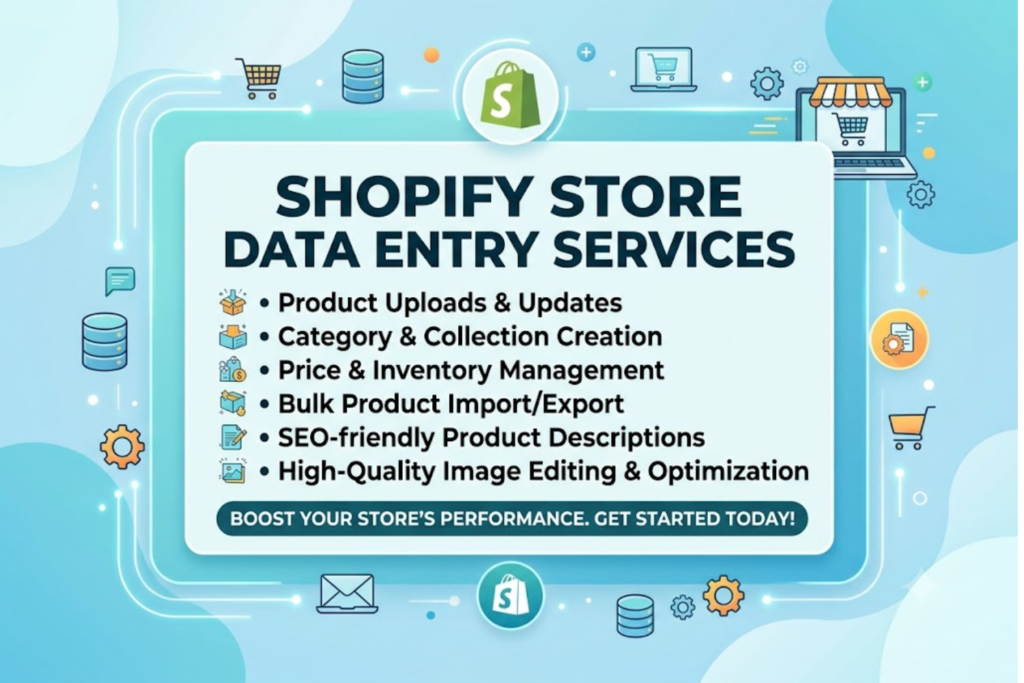
Standard services cover product title creation, SKU generation, pricing setup, variant configuration, collection assignment, image uploads with alt tags, vendor tagging, and meta title/description entry.
Is bulk CSV entry cheaper than manual entry?
Yes. Cleaning, mapping, and uploading data via CSV templates is significantly faster than entering items manually one by one. However, complex items with custom fields may still require manual verification.
How do service providers ensure product data accuracy?
Reputable agencies use a multi-stage Quality Assurance (QA) workflow. A secondary editor audits uploaded listings against source data to verify pricing, tags, links, and image displays before published items go live.
Can data entry specialists assist with store migrations?
Yes. Data entry teams regularly extract catalog data from platforms like Magento, WooCommerce, or BigCommerce, reformat the schemas to fit Shopify fields, and import the inventory accurately.
Conclusion
Outsourcing catalog updates allows growing brands to maintain accurate listings without overextension. Whether using per-product pricing for bulk launches or hourly retainers for routine updates, delegating data management protects internal bandwidth.
At Shopify Store Manager, we help e-commerce brands streamline inventory management, optimize product listings, and maintain accurate catalogs at competitive rates. Contact our team today for a tailored quote on your next catalog project.