
Running a Shopify store means managing more than products, orders, and customers. You also need to build relationships with shoppers, recover abandoned carts, encourage repeat purchases, and deliver relevant marketing messages at the right time. This is where Shopify Klaviyo Integration Services can make a meaningful difference.
For Shopify store owners, DTC brands, online retailers, and growing eCommerce businesses, connecting Shopify with Klaviyo creates a stronger foundation for personalized email and SMS marketing. Instead of relying on disconnected customer data or manually creating campaigns, your marketing team can use store activity to build more relevant customer journeys.
What Are Shopify Klaviyo Integration Services?
Shopify Klaviyo Integration Services involve configuring and optimizing the connection between a Shopify store and Klaviyo. The process can include customer data synchronization, event tracking, segmentation, automation setup, campaign configuration, and troubleshooting.
For a Shopify Store Manager, professional integration can help ensure that customer and shopping activity flows correctly into the marketing platform and supports useful automated workflows.
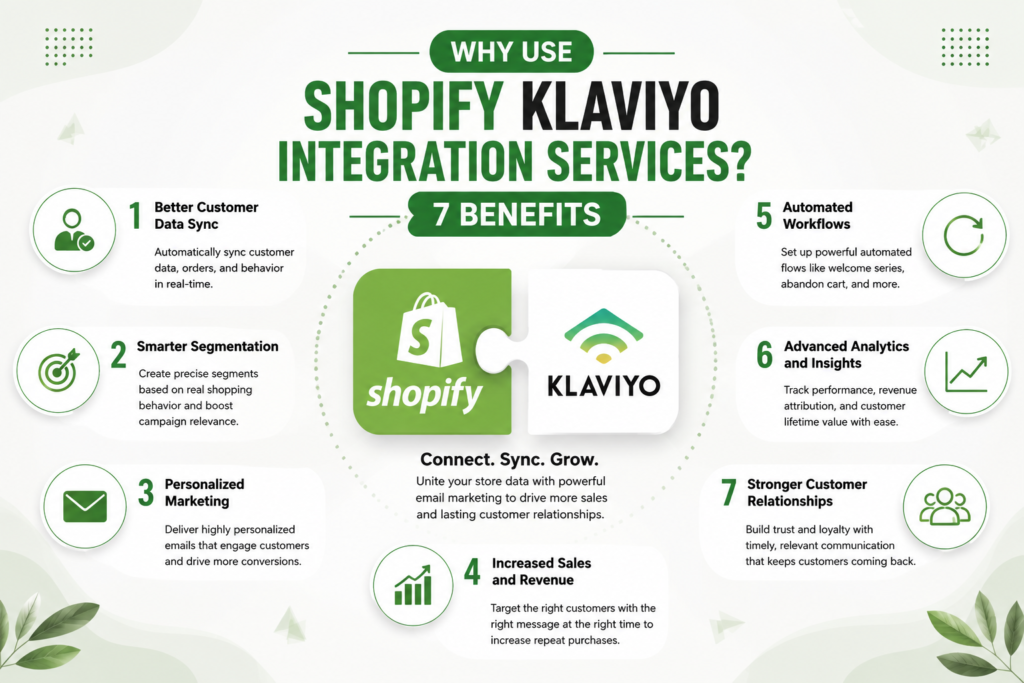
7 Benefits of Shopify Klaviyo Integration Services
1. Better Customer Data Synchronization
A properly configured integration helps connect important Shopify customer and shopping data with Klaviyo. This can provide marketers with the information needed to understand customer behavior and create more relevant communications.
2. More Personalized Marketing
Generic messages are less useful when customers have different interests and purchasing histories. Shopify Klaviyo integration allows businesses to create marketing based on factors such as products viewed, purchases, customer activity, and engagement.
This makes it easier to develop personalized email campaigns and targeted customer experiences.
3. Automated Abandoned Cart Recovery
Cart abandonment is a common eCommerce challenge. Integration can support automated abandoned-cart flows that remind shoppers about products they left behind.
Businesses can also create different messages based on customer behavior rather than sending the same reminder to everyone.
4. Stronger Customer Segmentation
Effective segmentation helps marketing teams send the right message to the right audience. Shopify data can support segments based on purchasing behavior, engagement, order history, and other relevant customer characteristics.
Useful segments may include:
- First-time customers
- Repeat buyers
- High-value customers
- Inactive subscribers
- Recent purchasers
- Customers interested in specific products
5. More Effective Automated Flows
Beyond abandoned-cart emails, businesses can build automated customer journeys for welcome messages, post-purchase communication, product recommendations, customer re-engagement, and other marketing objectives.
These workflows reduce repetitive manual work while maintaining consistent communication with customers.
6. Improved Marketing Efficiency
Managing customer data, campaigns, and automation separately can create unnecessary operational work. A well-configured Shopify-Klaviyo setup gives marketing teams a more connected workflow.
For small businesses and growing eCommerce brands, this can help marketing managers and email marketers spend more time improving strategy and less time resolving data or integration issues.
7. Better Foundation for eCommerce Growth
As an online store grows, marketing requirements become more complex. A properly implemented integration provides a stronger foundation for segmentation, personalization, automation, and customer retention initiatives.
For Shopify Plus merchants and established DTC businesses, professional integration can also help address more complex implementation and troubleshooting requirements.
Key Considerations Before Integration
Before implementing Shopify Klaviyo integration, review:
- Which customer and event data needs to be synchronized
- Whether existing tracking is working correctly
- Which automated flows are required
- How customer segments should be structured
- Whether consent and marketing preferences are handled appropriately
- How existing campaigns may be affected
- What testing is required before launching automation
A common challenge is assuming that connecting two platforms automatically creates an effective marketing system. The integration is only the foundation. Data quality, segmentation, messaging, testing, and ongoing optimization still matter.
How Shopify Store Manager Can Approach the Process
A practical approach is to start with business goals rather than simply connecting platforms. Identify the customer journeys that matter most, verify the required data, configure the integration, test key events, and then build automation around those verified data points.
Start with high-priority flows such as welcome, abandoned cart, and post-purchase communication before expanding into more advanced customer journeys.
FAQs
1. Why should Shopify stores integrate with Klaviyo?
Integration connects Shopify store activity with Klaviyo marketing capabilities, making it easier to personalize campaigns, segment customers, and automate customer communications.
2. Are Shopify Klaviyo Integration Services useful for small businesses?
Yes. Small businesses can use professional integration to establish reliable data synchronization and marketing automation without building the entire process manually.
3. Can integration help recover abandoned carts?
Yes. Shopify and Klaviyo can work together to support automated abandoned-cart communication based on shopper activity.
4. What can be automated after integration?
Depending on the store’s setup and marketing strategy, businesses can create welcome, abandoned-cart, post-purchase, re-engagement, and other customer lifecycle flows.
5. Does Shopify Klaviyo integration improve personalization?
It can. Access to relevant customer and shopping behavior data gives marketers more opportunities to create targeted messages and customer segments.
6. What are common Shopify-Klaviyo integration problems?
Common issues can include incorrect tracking, incomplete data synchronization, poorly configured flows, duplicate data, and segmentation errors. Testing and systematic troubleshooting can help identify these problems.
Conclusion
Shopify Klaviyo Integration Services can help Shopify merchants create a more connected eCommerce marketing operation. From better customer data and segmentation to abandoned-cart recovery and automated customer journeys, integration provides the technical foundation for more relevant lifecycle marketing.
Whether you run a small online store, a growing DTC brand, or a Shopify Plus business, begin by identifying your most important customer journeys and data requirements. Then make sure the integration is configured, tested, and aligned with your marketing goals. For businesses that want to improve their Shopify marketing infrastructure, working with Shopify Store Manager can be a practical next step toward a more organized and scalable setup.